

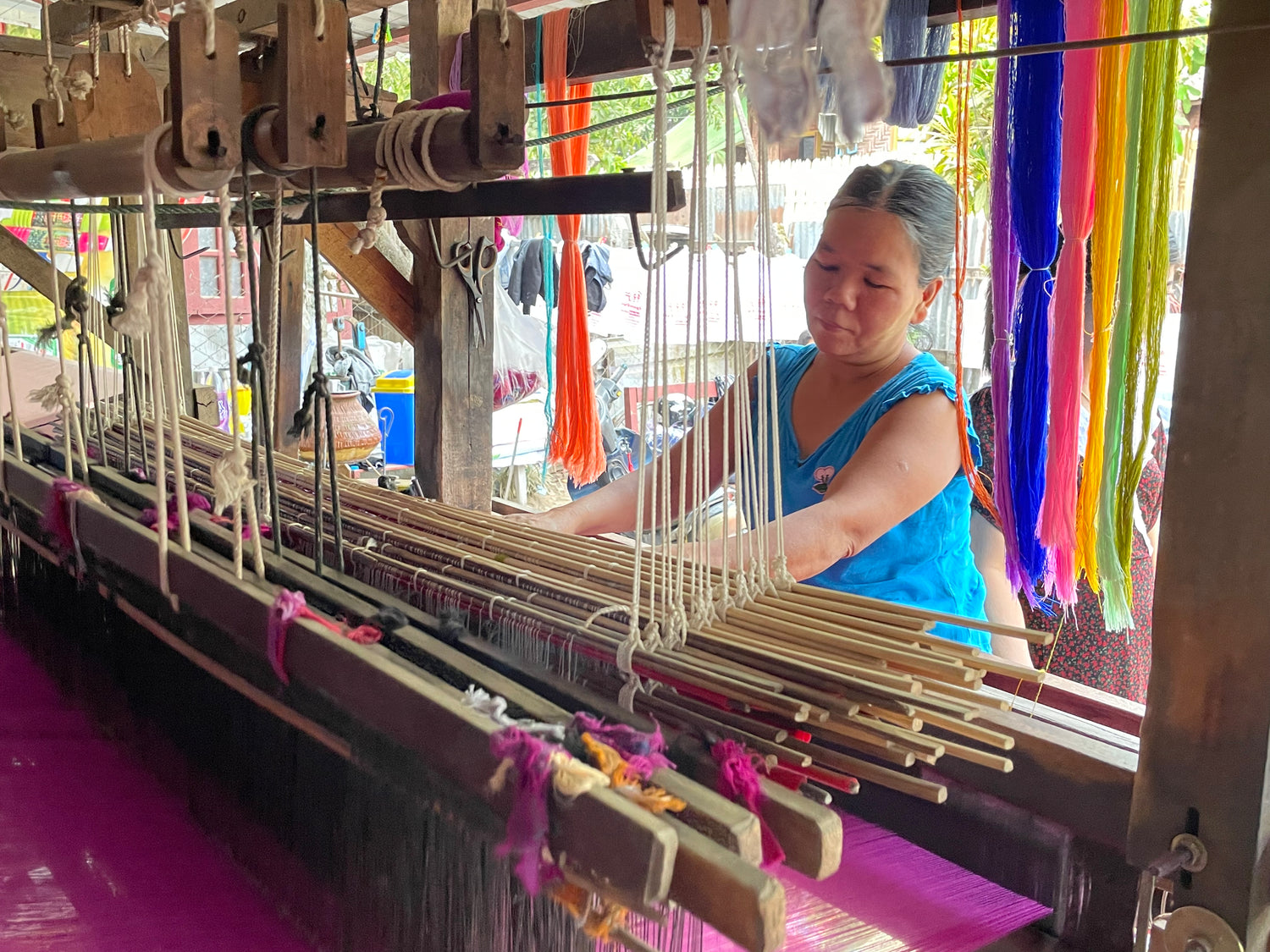
Less nomadic than the backstrap, the traditional frame loom is a key piece of textile craftsmanship in Southeast Asia. Used particularly in Myanmar , Vietnam and Laos , it allows the weaving of larger fabrics, often with complex and meaningful patterns.

This loom consists of a rigid wooden frame where the warp threads are stretched between two rollers.
The weaver, sitting in front of the frame, uses heddles to lift certain warp threads and create the opening (the shed).
A shuttle carries the weft through this opening, each row being beaten firmly with a comb or beater.
The pedal or lever system allows you to control the combination of raised threads, opening the way to complex patterns.
The warp threads are arranged and separated using a heddle and a cross stick. The weaver passes the weft thread between the warp threads, often using a shuttle.
Each pass is beaten with a wooden comb to tighten the threads . Complex patterns can be created by manipulating the warp threads using special techniques.

These patterns are reputed to be among the most difficult to achieve in Southeast Asia:
They require a very large number of heddles to handle the multiple yarn variations.
The patterns, often geometric and layered, are woven thread by thread, requiring extreme concentration and exceptional technical mastery.
Weaving can take several weeks for a single panel of fabric, due to the density of the designs and frequent configuration changes.
Each motif carries a strong cultural significance, linked to Kachin identity, rites and social status.

In Vietnam, ethnic minorities such as the Hmong and Thai use this type of loom for fabrics with very colorful floral or geometric patterns.
In Laos, weavers use this craft to create silks with Buddhist or animist designs, sometimes enhanced with gold thread.

Stability and precision: constant thread tension allows for high-quality fabrics.
Artistic complexity: Some designs, such as those of the Kachin, require extremely complex planning and execution.
Cultural transmission: these fabrics remain strong elements of identity, worn during traditional ceremonies and festivals.


