Interview with Yvonne Mathys Hereng, co-founder and president of Opportunity for Women
Why this commitment to women in Southeast Asia?
In 2018, I met a young Burmese woman, Julia Naw, who told me about her dreams of creating a social enterprise to help women in her country make a living from their crafts.
I have been involved with NGOs in Southeast Asia for a long time. I was able to discover the craftsmanship and weaving of Southeast Asia. It is a great resource, but it is in danger of disappearing if women are unable to make a decent living from it.
Meeting Julia – and other young women after that – who were eager to commit to bringing their artisanal wealth to life motivated me to help them succeed. Having arrested my professional activity, I was therefore available for a meaningful commitment.
We created with Julia, Youn Sone in 2019 for enable disadvantaged and uneducated women to have an income and access training that allows them to choose their lives.
Julia thus created a team of seamstresses in Yangon, the capital, whom she trained, and whom I helped with product design. Youn Sone sourced fabric from weavers, in refugee or displaced persons camps and in any case as close as possible to the villages where the weavers earn an income.
I got involved in Youn Sone because I am aware that women in many countries – and also in Asia – have more difficulty being autonomous, being able to choose their lives and manage them. The reasons are multiple, the lack of financial resources of course but also and often the lack of education and the weight of cultures that limit women.
I have a deep desire and also the will to help these women move towards more autonomy, to have more self-confidence, the ability to take responsibility for their choices and to carry out their projects. For me, it is helping them to choose their life by listening to them.
How was Opportunity for Women born?
It is also the fruit of another meeting with two women: Lucie Tailhades and Marie Van Haeckle.
Lucie volunteered in Vietnam, where she met ethnic minorities and discovered traditional clothing and weaving. Impressed by this expertise, she wanted to help them promote and develop their business. Marie, after volunteering in a silk weaving workshop in Cambodia, traveled through villages to meet the women who weave magnificent fabrics. She then created her first collections of cushions and clothing. Lucie and Marie then created TrendEthics together to help women by structuring several weaving cooperatives in Laos and Vietnam. The fabrics were transformed into cushions and sold in France.
We met in Myanmar, where they were looking to develop a cooperative. Our paths crossed, and it was the beginning of a wonderful collaboration. We began working more closely together during COVID-19, producing and selling masks, raising funds, and organizing online sales. It then seemed much more effective to join forces by creating a joint structure: Opportunity For Women was born in 2023.
What are the goals of Opportunity for Women and how can we achieve them?
Opportunity for Women wants to help women who want to make a living from their crafts, to do so in the 21st century. OFW provides them with the support, training, know-how and initial financial funds to succeed.
The women we work with live in very remote areas with little access to education, health, and very little access to employment. They have few means to be independent, to develop themselves. Above all, in this context, they also have very little self-confidence because their know-how is not valued by young people who dream of dressing in Chinese or Korean fast fashion or working in a call center. Traditional crafts are no longer seen as something precious and valuable.
I met weavers who have exceptional know-how that deserves to be valued. We collaborate to help them adapt their art to make it more contemporary while respecting their traditions. We encourage them and help them reclaim their know-how in natural dyes, a know-how that existed in Myanmar, Cambodia, Laos, and Vietnam but which has been somewhat lost in recent years with the arrival of easier-to-use chemical dyes. We were able to find several experts who volunteer to help them update their knowledge and produce better-quality fabrics.
The value of their creations comes largely from weaving, however we also manage to promote sewing and design. Here again, we are not alone but work with expert volunteers and thus manage to inspire and motivate young women to get involved in sewing and creation. I am proud that together we succeed in releasing new products each year and having increasingly varied collections.
So, they are happy to see on Instagram or on the web that their dresses are being worn in France, that their cushions decorate Parisian living rooms or even hotel rooms. It gives them confidence. This is true for all weavers, but it is also true for seamstresses who realize that they can design contemporary products with high added value.
This implies that our creations have a certain price – affordable in Europe but high-end in their countries. This limits the local market to tourists and wealthy populations – if they are willing to pay the right price. Our initial model of selling locally can therefore only work in tourist areas. Many of the weavers live off the tourist routes; since the coup d'état in Burma, tourism has stopped.
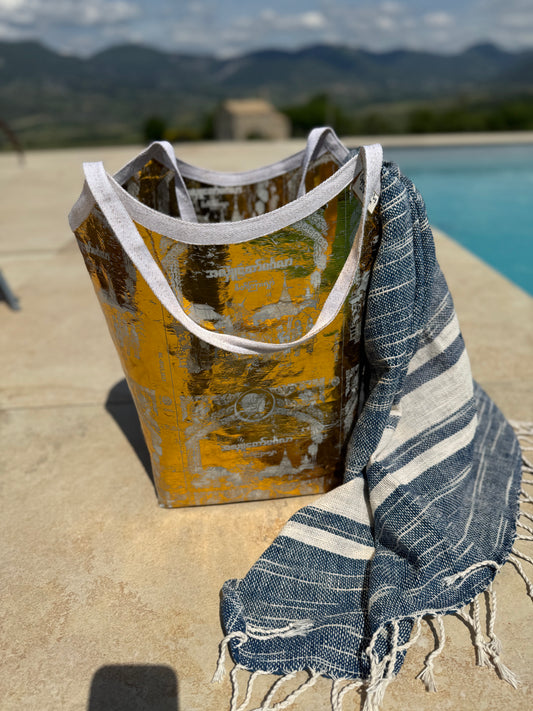
We have therefore developed sales channels by relying heavily on word of mouth for private sales thanks to a growing network of volunteers and ambassadors, and we participate in events that are always listed on our website. My husband and I have launched the experiment of our own boutique in a tourist spot – Yakan-le Comptoir in Buis les Baronnies in Drôme Provençale. The boutique is self-funded by the sale of local products and a bistro activity, which allows us to donate the entire sale price of Opportunity for Women products to the association.
And today, what are the challenges?
The first challenge is to increase and diversify the number of sales outlets to increase our impact and raise awareness of this craft and the situation of ethnic minority women. We are looking for sales outlets that share this vision and understand our mission. We don't just sell a beautiful product; we tell a story and are committed to sharing that this product helps women gain autonomy and self-confidence by seeing the products worn or used outside their village. We therefore need to find more targeted sales outlets to convey these messages.
The traceability of our products is another challenge. We work with women who live in villages far away from nowhere and who sometimes only speak the language of their minority, not that of their country, and even less so English. They don't have the opportunity to source thread or dye as we would like. It's difficult to ensure the traceability of all the products used. This is a limitation for large-scale sales, and it's something we're working on. Concretely, we were able to help one of our seamstresses train in ecoprinting and set up her workshop. This has a double benefit: we can source directly, and she has significantly increased her income.
Finally, we don't want to assist women in Southeast Asia by sending them money. We want to help them live off their know-how and have the pride of generating an income with what they have produced so as not to feel assisted. Crafts are a good vector, but we see the need to provide broader support, particularly in terms of education. For example, we have just funded a summer camp for young girls in minority communities in Vietnam where we work with weavers. In these regions, girls sometimes don't even complete compulsory schooling and don't access higher education because families are instead looking to marry them off to receive a dowry and have fewer mouths to feed, or are looking to have them work in the fields. We decided to support young Vietnamese people who have launched voluntary tutoring camps and who are achieving very good results. This is also to support the women of this region.
To carry out all these actions, product sales are not enough. We therefore decided to create a new association, Opportunity For Women Development, whose income comes exclusively from donations. It aims to develop projects in education, empowerment, entrepreneurship, and the promotion of traditional skills. This way, we can have a deeper impact—helping women who want to make a living from their crafts and helping others gain the means to achieve their dreams and aspirations.
Interview with Yvonne Mathys-Hereng
Co-founder and President of Opportunity for Women