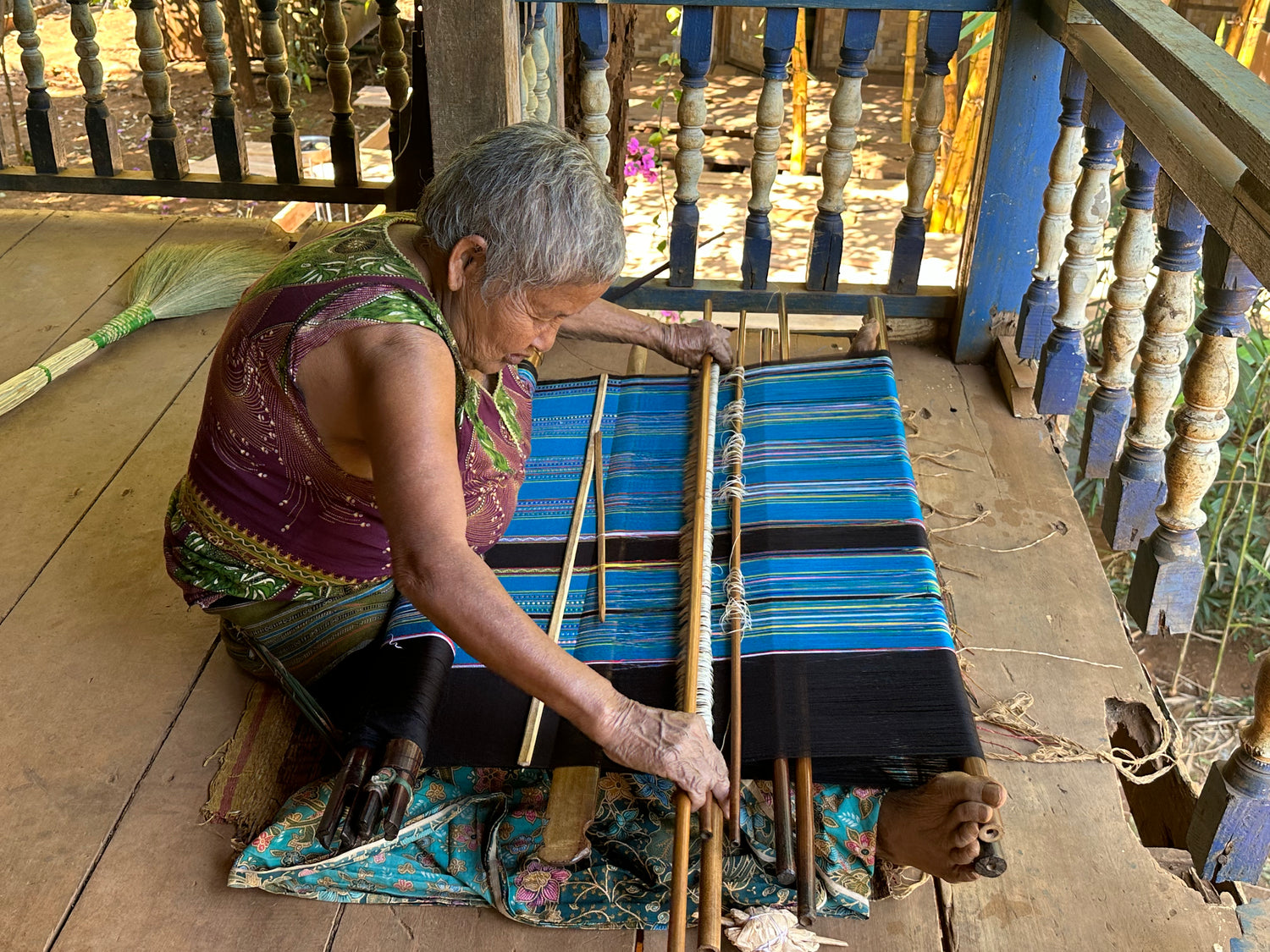
Backstrap weaving is a traditional, manual method used for millennia in many cultures in Asia, Latin America, and Africa. It is characterized by the use of a simple, portable loom that attaches to the weaver's body.

The loom consists of two parallel bars connected by warp threads.
One of the bars is fixed to a stationary point (tree, post, wall).
The other is attached around the weaver's waist with a belt (often made of leather or fabric).

The weaver sits on the ground and maintains the tension of the warp by leaning backward.
By pulling on the belt with his body, he tightens the warp threads.
As he gets closer, he loosens the warp to insert the weft. (video)
The warp threads are arranged and separated using a heddle and a cross stick.
The weaver passes the weft thread between the warp threads, often using a shuttle.
Each pass is beaten with a wooden comb to tighten the threads. Complex patterns can be created by manipulating the warp threads using special techniques.

Mobility: the loom is light and easily transportable.
Flexibility: The width of the fabric is limited by the weaver's wingspan, but lengths can be long.
Artisanal richness: this technique allows the creation of geometric, symbolic and very colorful patterns.

In Central America (Guatemala, Mexico, Peru), it is still widely used by Mayan or Andean women to produce traditional textiles.
In Southeast Asia (Vietnam, Laos, Indonesia), it is also used to weave fine fabrics such as ikat .