

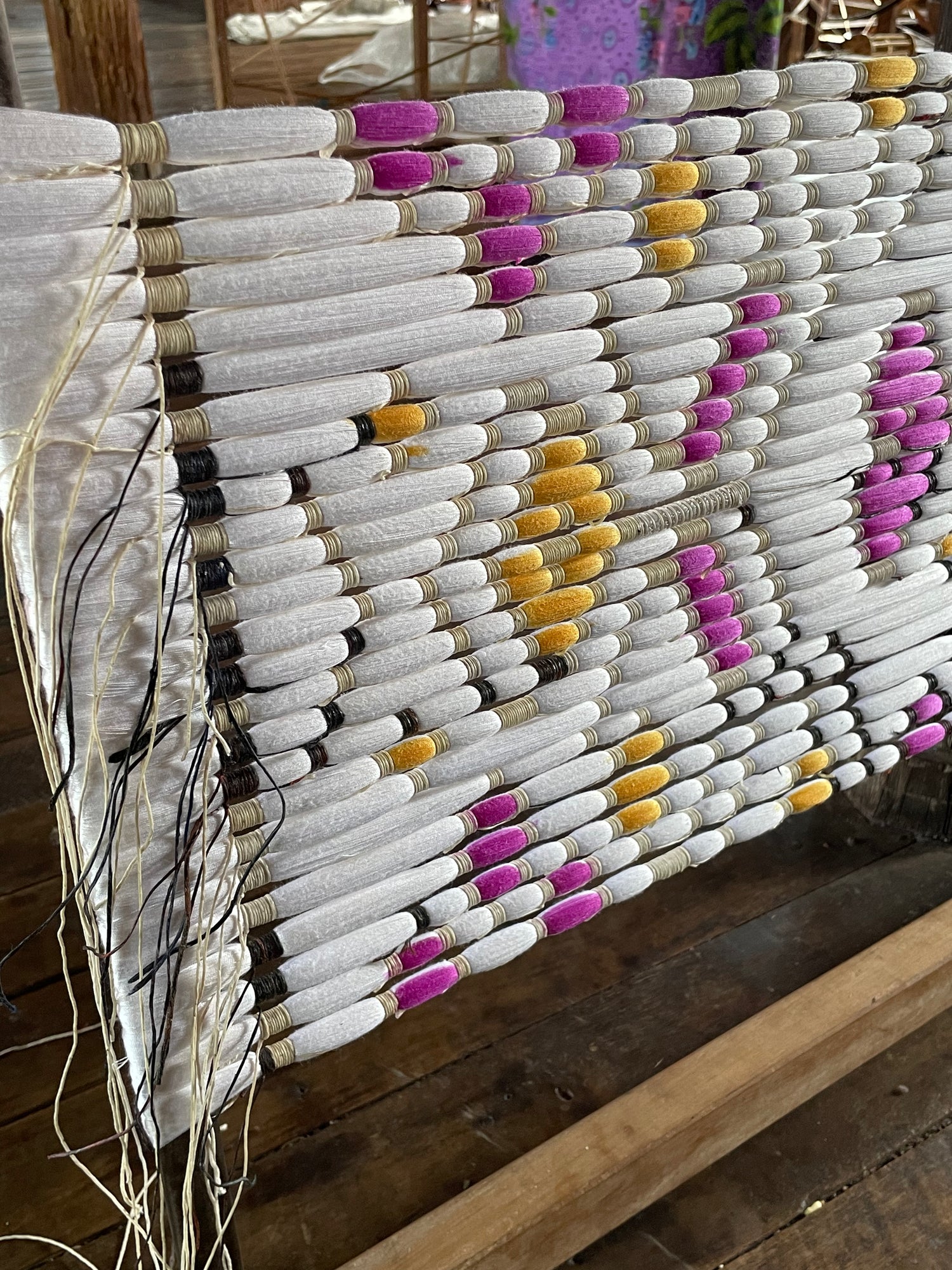
Among the most sophisticated techniques in the textile world, ikat stands out for its unique method: the patterns are dyed before weaving even begins . Found from Asia to the Middle East to Latin America, this practice requires precision, patience, and artistry.

In ikat, the designs are not added after the fact, but are previously inscribed in the threads by a process of ligature and dyeing.
The warp, weft, or both threads are knotted, protected and then dyed, so as to preserve certain areas of the color.
Each shade requires a different knotting, giving rise to complex patterns.
In this photo, we can clearly see the dyed parts of the yarn !
Planning the pattern and tying the threads according to the drawing.
Successive dyeing, each color involving new protections.
Weaving on a traditional loom , often with a fixed frame, with careful adjustment of the patterns.

Warp Ikat: The warp threads carry the pattern before weaving.
Weft ikat: the design is formed as the weft passes.
Double ikat: Both sets of yarns are dyed, requiring great precision to align the patterns.

In Myanmar, particularly in the Inle Lake region, ikat is a living and distinctive textile skill.
The artisans, mainly from the Intha community, use traditional looms to create fabrics with geometric or floral patterns, tinted in natural reds, blues and browns.
These fabrics, locally called "Acheik", are renowned for their characteristic undulations and finesse.
Weaving is carried out in family workshops, perpetuating a tradition passed down from generation to generation and associated with prestigious cultural and clothing customs.

Unique visual effect: a subtle blur, signature of ikat, due to the slight shift between the dyed threads and the weave.
Artisanal complexity: requires great technical mastery and a developed artistic sense.
Cultural dimension: the patterns carry symbolic and identity meanings.


